

Quick Summary
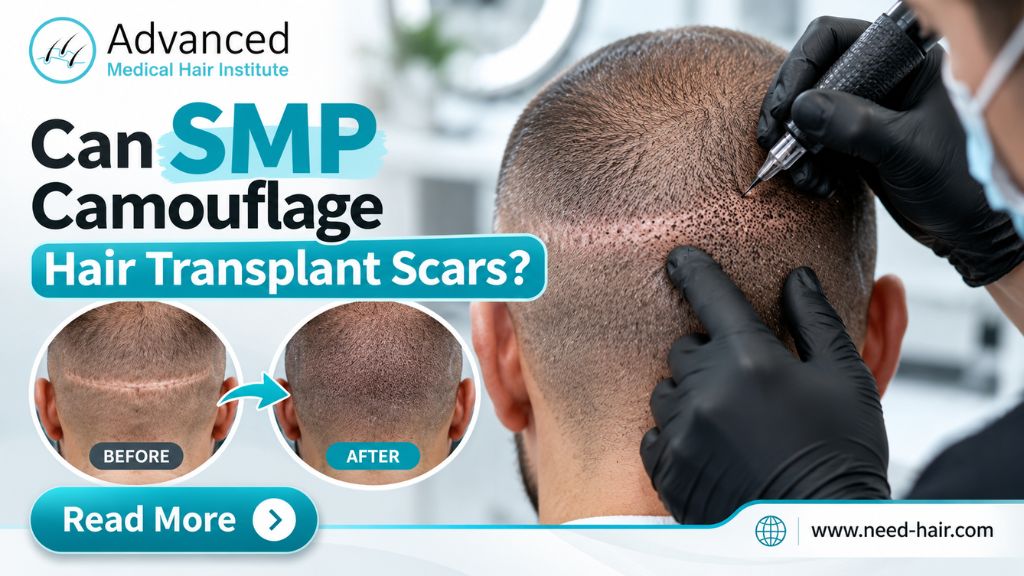
Scalp micropigmentation can reduce the visual contrast of some healed hair transplant scars by placing small pigment deposits in the skin. It does not remove scar tissue or grow hair. Advanced Medical Hair Institute offers SMP scar camouflage, with suitability depending on scar characteristics, healing, surrounding hair, and realistic expectations.
A transplant scar may be easy to cover with one haircut and noticeable with another. If you want a shorter style, the contrast between pale scar tissue and surrounding hair can become the main concern.
Scalp micropigmentation, commonly called SMP, is one possible way to reduce that contrast. Advanced Medical Hair Institute offers this service for appropriate patients, including camouflage of linear FUT scars and small FUE donor scars.
The aim is an improvement in appearance. It should not be described as erasing a scar or replacing missing follicles.
How does SMP camouflage a transplant scar?
SMP places tiny pigment deposits in the skin to create the visual impression of closely cut hair. In a scar, carefully matched pigment may make the treated area less distinct from the surrounding scalp.
Our scalp micropigmentation service describes its use for both linear and punctate transplant scars. It also explains the technique’s cosmetic role: the result is an appearance of coverage, not new hair growth.
Scar tissue can behave differently from unscarred skin. ISHRS describes scars as particularly demanding areas for SMP, so a result seen on a normal scalp is not a dependable prediction for a scar.
Can SMP treat both FUT and FUE scars?
It may help with either, but their patterns differ. FUT typically leaves a linear donor scar, while FUE leaves multiple small scars where units were removed.
| Scar pattern | What camouflage may address | What remains unchanged |
|---|---|---|
| Linear FUT scar | Contrast along a healed donor line | Scar width, contour, and texture |
| Small FUE scars | Pale dots visible within short hair | Missing follicles at harvested sites |
| Thinned donor appearance | Some visible scalp contrast | Actual hair density and donor supply |
For background on the harvesting methods, our existing FUE versus FUT article explains why the donor patterns differ. A consultation should assess your actual scar rather than infer suitability from the procedure name.
When should a scar be assessed for SMP?
The scar needs to be sufficiently healed and stable before cosmetic tattooing is considered. There is no single calendar date that establishes readiness for every scar.
Tell the clinician when the surgery occurred, whether the scar has changed, and whether it is painful, red, raised, itchy, or otherwise symptomatic. Active inflammation or an unexplained change should be evaluated before focusing on camouflage.
Ask whether a conservative test area or staged approach would be useful. The appropriate plan depends on the scar and provider’s assessment; it should not be assumed from a standard package.
What affects how natural the result looks?
Pigment selection, placement, scar characteristics, and the surrounding hairstyle all matter. A shade that appears plausible under one light may look different in daylight or against longer hair.
Bring photographs of the haircut you actually want. Ask to view relevant healed examples involving comparable scars, rather than only freshly treated photographs. Immediate appearance can differ from the healed result.
Discuss how future changes in hair color, donor thinning, or hairstyle could affect the match. A plan should account for the surroundings, not just the visible pale line or dots.
What should you ask before treatment?
- What improvement is realistic for this scar’s color and texture?
- How will the pigment be matched to my intended hairstyle?
- What risks apply, including infection, pigment mismatch, or an unsatisfactory result?
- What aftercare and follow-up are recommended?
- Could touch-ups or future adjustments be needed, and how are they priced?
Is SMP the only option for a visible donor scar?
No. Depending on the scar, alternatives may include a different hairstyle, surgical scar revision, or carefully selected transplantation into scar tissue. These approaches have different goals and limitations.
If additional surgery is being considered, discuss whether FUE transplantation has a role in your individual plan. Further harvesting or grafting is not suitable for every scar. Assessment should consider blood supply, available donor hair, and the cause of the visible change.
Common questions about SMP for scars
Will SMP remove the scar?
No. It changes visual contrast. Raised, indented, or wide scar tissue can remain apparent even when the color blends better.
Will hair grow from the pigmented dots?
No. Pigment does not create follicles. SMP and transplantation provide different types of change.
Will the result need maintenance?
It may. Pigment appearance can change, and follow-up or touch-ups may be appropriate. Ask about likely maintenance and costs without assuming a permanent color match.
Plan around a healed result
Bring your surgical history, preferred haircut, and questions about scar texture to the assessment. Contact Advanced Medical Hair Institute to discuss whether SMP could improve your scar’s appearance and what limitations to expect.
 ICONIER Digital Agency