

Quick Summary
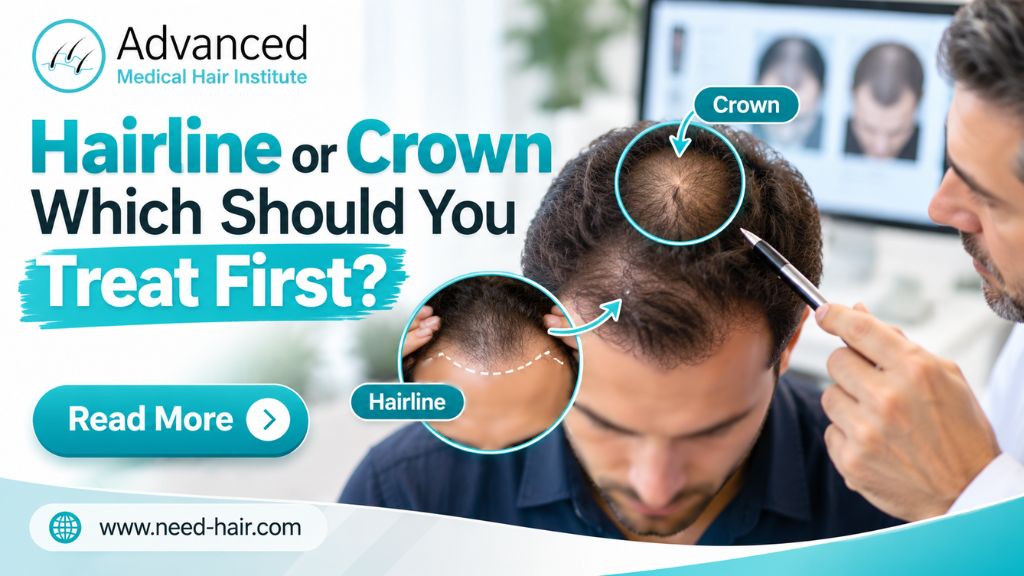
There is no universal rule that the hairline or crown must come first. Planning depends on your priorities, donor supply, current thinning, and likely future loss. Advanced Medical Hair Institute evaluates how a proposed transplant will look across the scalp over time, including areas that may need treatment much later.
The crown may bother you most in photographs, while the hairline changes how your face looks in the mirror. When both areas are thinning, choosing where to start can be more difficult than choosing a procedure.
At Advanced Medical Hair Institute in Las Vegas, that choice belongs within a broader plan. Treating the most noticeable spot today should not make the next stage of hair loss harder to manage.
Why can you not simply restore every area densely?
A transplant moves existing follicles from a donor region to another part of the scalp. It does not create an unlimited supply of new follicles. The available donor reserve must cover the present goal and possible future needs.
“Density” also describes an appearance, not just a graft count. Hair thickness, curl, color contrast, direction, and styling affect how much scalp shows. Two people with similar thinning can need different plans.
Our existing guide to hair transplant graft requirements provides background for discussing coverage. Ask the surgeon what the donor assessment allows, rather than choosing a number before the examination.
When might the hairline receive priority?
The frontal hairline frames the face and is prominent in everyday conversation and photographs taken from the front. For a patient whose main concern is frontal recession, restoring an appropriate frame may be the most meaningful first goal.
The design still needs to suit likely future thinning. A very low or extensive hairline can commit a large amount of donor hair to a shape that becomes difficult to support later.
Ask to see the proposed design from the front and sides. Discuss how it will blend into the midscalp, not just how the leading edge will look immediately after surgery.
When might the crown be the main concern?
Crown treatment may be appropriate when that is the patient’s main priority and the donor assessment supports it. Planning needs to consider the crown’s surface area, existing hair, and natural whorl direction.
An enlarging crown can require more donor resources than it initially appears to need. ISHRS guidance on corrective surgery specifically cautions that treating the crown too aggressively at a young age can use valuable donor hair prematurely.
This is a reason for careful planning, not a blanket rule against crown transplantation. Your concerns should be heard, and the surgeon should explain the trade-offs.
How should you compare the options?
| Question | Why it changes the plan |
|---|---|
| Which view bothers you most? | Establishes the improvement you value most |
| Is thinning changing quickly? | Raises questions about timing and future coverage |
| How much donor hair is safely available? | Limits the feasible treatment scope |
| What remains untreated? | Makes the expected overall appearance clearer |
| Would staged treatment fit your goals? | Allows discussion of sequence, cost, and recovery |
Bring front, side, overhead, and back photographs. A single flattering angle can conceal the transition between treated and untreated areas.
Could both areas be treated in one session?
Sometimes, but the answer depends on the surgical assessment. Dividing a limited donor supply between two large areas may provide lighter coverage than a focused procedure. Ask for the expected trade-off in plain language.
Does FUE or FUT settle the priority question?
No. Harvesting method and recipient-area priorities are related but separate decisions. FUE transplantation and FUT transplantation collect donor follicles differently; neither label alone determines where those follicles should go.
Discuss donor preservation, scar patterns, hairstyle preferences, and the possibility of later procedures. A technique should support the plan rather than substitute for one.
Common questions about treatment order
Is the crown less important than the hairline?
Not to every patient. The relevant question is which improvement matters to you and whether the proposed allocation remains sensible over time.
Can medication change the surgical plan?
It may. If medically appropriate treatment helps stabilize or improve native hair, the surgical priorities may change. The response needs assessment rather than assumption.
Should I choose the area with the most visible scalp?
Visibility matters, but so do donor limits, future progression, and how the regions connect. Ask the surgeon to explain the whole-scalp appearance of each option.
Ask for a plan beyond the first procedure
Before booking, ask what the proposed transplant would leave available for later needs. Arrange a consultation at Advanced Medical Hair Institute to discuss your priority view, donor reserve, and a realistic sequence of treatment.
 ICONIER Digital Agency