

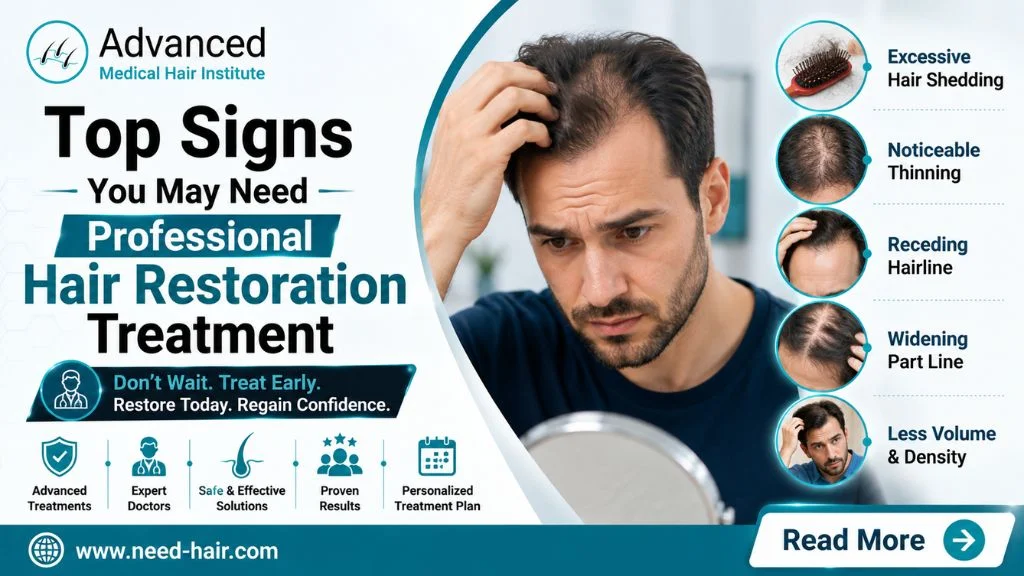
Most people spend months, sometimes years hoping their hair will “come back on its own” before finally seeking help. It’s completely understandable. Hair loss tends to arrive gradually, and it’s easy to minimize what you’re seeing in the mirror or write off what’s collecting in your brush as normal daily shedding.
But here’s what many people don’t realize: hair restoration is significantly more effective when it begins early. Waiting until loss is advanced doesn’t just limit your treatment options it can make some solutions no longer viable.
Knowing when to act is the first and most important step. Below are the clearest signs that it’s time to stop waiting and book a professional consultation.
Sign 1: You’re Losing More Than 100 Hairs Per Day Consistently
It’s normal to shed between 50 and 100 hairs daily. Hair goes through natural growth cycles, and shedding is part of that process. But if you’re consistently finding hair on your pillow, clogging the shower drain, and filling your brush or comb with noticeable amounts every single day especially over a period of several weeks that’s a meaningful signal.
Temporary shedding after illness, stress, or a nutritional deficiency often resolves on its own. But persistent, ongoing excessive shedding rarely does without intervention. A dermatologist or hair restoration specialist can run tests to determine whether you’re experiencing normal cycling or something that requires treatment.
Sign 2: Your Hairline Is Visibly Receding
This is one of the most unmistakable signs in men and it’s something many try to rationalize away for far too long. Compare photos of yourself from two or three years ago. Is your hairline in the same place? If your temples appear to have moved backward, your hairline has a new M-shape, or the front of your scalp feels further from your face than it used to, you’re experiencing a receding hairline that warrants attention.
For women, the equivalent is often a widening center part or a front hairline that appears to be thinning or becoming more “transparent” near the temples. These are early signs of androgenetic alopecia and respond extremely well to early intervention.
Sign 3: Your Crown or Scalp Is Becoming Visible
Thinning at the crown, the top-back area of the head, is another classic pattern for men experiencing male pattern baldness. You might notice it first in photos taken from above, or a barber might comment on it. The scalp becoming visible through the hair, a growing bald spot, or a circular patch of significantly reduced density are all signs that hair follicles are miniaturizing under the influence of DHT.
In women, this often shows up as a visible scalp along the part line or an overall reduction in hair volume across the top of the head. The hair may look flatter, feel thinner between your fingers, or simply not hold a style the way it once did.
Sign 4: Your Ponytail or Hair Volume Has Noticeably Decreased
This is a sign that women in particular report often before other, more visible symptoms appear. If your ponytail has shrunk noticeably in circumference, if your hair feels significantly lighter when tied up, or if you need to wrap your hair tie more times than you used to, that reduction in volume is telling you something important: your overall hair density is declining.
This kind of diffuse thinning can be sneaky as there’s no single bald spot to point to, but it represents a meaningful loss of follicle health that should be professionally evaluated.
Sign 5: Patches of Hair Loss Appearing Suddenly
Sudden, patchy hair loss particularly in oval or circular shapes may indicate alopecia areata, an autoimmune condition in which the body’s immune system attacks hair follicles. This requires a different treatment approach than pattern baldness and should be evaluated by a specialist as soon as possible.
Unlike gradual pattern loss, alopecia aerate can develop and spread rapidly in some individuals. Early treatment significantly improves the chance of full or near-full regrowth.
Sign 6: You’ve Noticed Hair Loss after a Major Life Event
Significant physical or emotional stress, surgery, illness, childbirth, bereavement, or even a period of severe anxiety can trigger a form of hair loss called telogen effluvium. This typically appears 2–3 months after the triggering event and presents as diffuse, widespread shedding rather than pattern loss.
The good news is that telogen effluvium is often temporary and reversible. But “often” isn’t “always” and some cases persist or reveal an underlying susceptibility to pattern hair loss. Getting a professional evaluation confirms whether your shedding is temporary or needs proactive treatment.
Sign 7: You’ve Tried Over-the-Counter Products Without Success
Drugstore shampoos, supplements, and topical products are heavily marketed to people experiencing hair loss and while some (like minoxidil) have genuine clinical backing, many offer little beyond hope. If you’ve been using OTC hair loss products for 6+ months without meaningful improvement, that’s a clear signal that a professional-grade approach is needed.
A hair restoration specialist can determine whether you’re using the right products for your type of hair loss, prescribe clinically appropriate treatments, or discuss whether a procedure would be more effective for your situation.
Sign 8: Your Hair Loss Is Affecting Your Confidence or Mental Health
This is perhaps the most important sign of all and the one that’s most commonly overlooked because it feels too subjective to “count.” But the emotional impact of hair loss is well-documented and entirely valid. Studies consistently show that hair loss significantly affects self-esteem, body image, and quality of life in both men and women.
If you find yourself avoiding social situations, constantly checking mirrors with anxiety, reluctant to take photos, or feeling embarrassed in professional settings because of your hair, that emotional weight is reason enough to seek help. You don’t have to reach a certain threshold of “visible” hair loss before your experience is worth addressing.
What Happens at a Professional Hair Restoration Consultation?
Seeking professional help doesn’t automatically mean surgery or a lifelong commitment to treatment. A reputable consultation is primarily educational it’s a chance for you to understand what’s happening, why, and what your options are.
At Advanced Medical Hair Institute, an initial consultation includes:
- Detailed scalp analysis using clinical assessment tools
- Review of your medical and family history relevant to hair loss
- Classification of your hair loss pattern and severity
- Honest assessment of your candidacy for various treatments
- A clear explanation of expected outcomes, timelines, and costs
- A no-pressure environment where all your questions are welcomed
You’ll leave with clarity whether that’s a treatment plan, a monitoring strategy, or simply the peace of mind that comes from understanding what’s actually happening to your hair.
The Cost of Waiting
Here’s something worth knowing: hair follicles don’t come back once they’re gone. Once a follicle fully miniaturizes and becomes permanently inactive, no treatment surgical or otherwise can restore it. The treatments available to you, and the results they can achieve, are directly tied to how many healthy follicles remain.
Early action means more options. More options mean better outcomes.
Frequently Asked Questions
Q: How much hair loss is considered normal?
Losing 50–100 hairs per day is within the normal range. Persistent loss significantly above this level especially with visible thinning warrants professional evaluation.
Q: Can hair loss stop on its own?
Temporary forms like telogen effluvium often resolve once the underlying trigger is addressed. Androgenetic (pattern) hair loss typically progresses without treatment.
Q: At what age should I see a specialist for hair loss?
There’s no minimum age. Hair loss can begin in the late teens or early twenties. Earlier evaluation generally means more treatment options.
Q: Will a consultation commit me to a treatment plan?
No. A consultation at Advanced Medical Hair Institute is informational and pressure-free. You’ll receive expert advice and leave with options, and the decision is entirely yours.
Q: Can stress really cause hair loss?
Yes. Significant physical or emotional stress can trigger telogen effluvium, causing widespread shedding that typically begins 2–3 months after the stressful event.
Conclusion
Hair loss responds to treatment far better when it’s caught early. Whether you’re noticing a receding hairline, a thinning crown, or a reduced ponytail, these signs are your signal to act.
Don’t wait for the loss to become advanced before seeking help. The sooner you understand what’s happening, the more you can do about it.
 ICONIER Digital Agency