

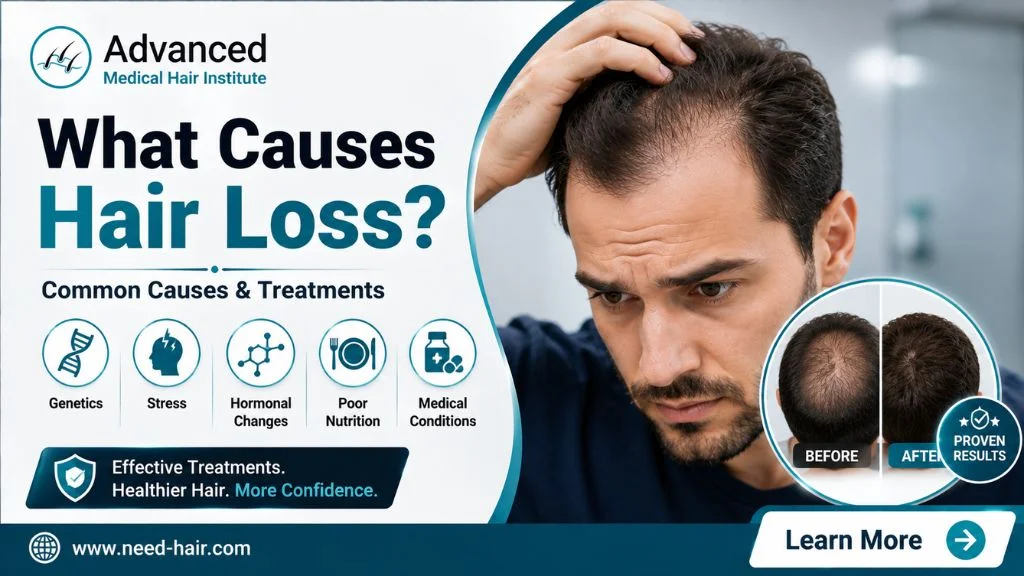
Hair loss is one of those experiences that can feel deeply personal and uniquely yours, even though it’s actually one of the most common concerns in the world. Millions of men and women deal with it at some point in their lives. Despite how widespread it is, hair loss remains widely misunderstood. People blame the wrong things, try the wrong treatments, and most commonly, wait far too long before seeking proper help.
This guide cuts through the confusion. We’ll explore the most common causes of hair loss, how to identify what’s actually behind yours, and what the most effective modern treatments are for each cause.
How Hair Actually Grows (And Why It Stops)
Before understanding why hair falls out, it helps to understand how it grows. Every hair on your scalp is produced by a follicle; a tiny organ embedded in the skin. Each follicle cycles through three stages:
- Anagen (Growth Phase): The hair actively grows. This phase lasts 2–7 years for scalp hair.
- Catagen (Transition Phase): The follicle shrinks and detaches from its blood supply. Lasts 2–3 weeks.
- Telogen (Resting Phase): The hair rests in the follicle before being shed. Lasts 3–4 months, then a new anagen cycle begins.
Hair loss happens when this cycle is disrupted, follicles are forced into telogen prematurely, when anagen shortens and telogen lengthens, or when follicles gradually miniaturize and stop producing hair altogether.
Cause 1: Androgenetic Alopecia (Male/Female Pattern Hair Loss)
This is the most common cause by far. Androgenetic alopecia affects approximately 50 million men and 30 million women in the United States. In men, it typically progresses along the Norwood Scale from a receding hairline, to temple recession, to crown thinning, and eventually more extensive baldness. In women, it follows the Ludwig Scale diffuse thinning across the top of the scalp without a receding frontal hairline.
The cause is a combination of genetic predisposition and sensitivity to DHT (dihydrotestosterone), a hormone derived from testosterone. In susceptible follicles, DHT binds to receptors and triggers a process of progressive miniaturization. Follicles produce finer, shorter hairs with each cycle until they eventually stop producing visible hair at all.
Most effective treatments: Growth factors & exosomes (for preservation and stimulation), FUT hair transplant (for restoration), and Minoxidil & Dutasteride for prescription therapy.
Cause 2: Telogen Effluvium
Telogen effluvium is the second most common cause of hair loss and one of the most frequently misdiagnosed. It occurs when a significant physical or emotional stressor forces a large number of follicles simultaneously into the telogen (resting) phase, resulting in widespread shedding approximately 2–3 months after the triggering event.
Common triggers include:
- Major illness or surgery
- Childbirth (postpartum hair loss)
- Extreme emotional stress or grief
- Rapid significant weight loss or crash dieting
- Severe nutritional deficiency (especially iron, protein, zinc, or vitamin D)
- Starting or stopping certain medications
- High fever or COVID-19
The shedding can be alarming but telegenic effluvium is often temporary and self-resolving once the trigger is addressed. However, if the underlying trigger is ongoing, or if the patient has an underlying predisposition to pattern loss, professional intervention may be needed.
Most effective treatments: Addressing the underlying trigger, non-surgical hair restoration, and prescription therapies.
Cause 3: Alopecia Areata
Alopecia areata is an autoimmune condition in which the immune system mistakenly attacks hair follicles, causing them to enter a dormant state. It presents as a sudden loss of typically smooth circular or oval bald patches on the scalp; though it can affect eyebrows, eyelashes, or body hair as well.
The condition affects about 2% of the global population and can occur at any age, including in children. In some cases, it progresses to alopecia totals (complete scalp hair loss) or alopecia universalist (complete body hair loss), though many patients experience partial or full spontaneous regrowth.
Because the follicles aren’t destroyed, merely suppressed, treatment can be effective, particularly when begun early.
Most effective treatments: Non-surgical hair restoration and prescription therapies.
Cause 4: Nutritional Deficiencies
Hair follicles are among the most metabolically active cells in the body. They require a consistent supply of nutrients to function properly. Deficiencies in several key nutrients are directly linked to hair loss and shedding:
- Iron deficiency (anemia): One of the most common nutritional causes of hair loss in women
- Vitamin D deficiency: Linked to alopecia areata and telogen effluvium
- Zinc: Important for hair tissue growth and repair
- Protein: Hair is made of keratin; inadequate dietary protein limits production
- Biotin: While actual biotin deficiency is rare, it does affect hair and nail quality
- B vitamins including B12 and folate
Blood tests can identify deficiencies. Appropriate supplementation, alongside dietary improvement, often produces meaningful improvement in shedding and hair quality within a few months.
Most effective treatments: Targeted supplementation based on blood test results, dietary adjustments, non-surgical hair restoration and prescription therapies.
Cause 5: Hormonal Changes and Imbalances
Hormones have a profound effect on hair follicle behaviour. Beyond DHT and its role in pattern baldness, several hormonal shifts and conditions can trigger or worsen hair loss:
- Thyroid disorders (both hypothyroidism and hyperthyroidism) can cause diffuse shedding
- Polycystic Ovary Syndrome (PCOS) in women; elevated androgens cause both facial hair and scalp hair loss
- Postmenopausal estrogen decline reduces the protective effect of estrogen on follicles, often triggering pattern loss
- Postpartum hormonal shifts cause a drop in estrogen after delivery, and is the primary driver of postpartum telogen effluvium
- Insulin resistance can be linked to androgenetic alopecia in both men and women
A comprehensive hormonal workup is often an important step in understanding hair loss that doesn’t seem to fit the standard pattern.
Cause 6: Scalp Conditions
Chronic scalp conditions that disrupt the follicle environment can contribute to or accelerate hair loss:
- Seborrheic dermatitis: Chronic inflammation and flaking that, if severe, can impair follicle health
- Scalp psoriasis: Thick scaling and inflammation
- Fungal infections (tinea capitis): Particularly in children; causes patchy loss
- Frontal fibrosing alopecia: A scarring alopecia affecting the hairline, particularly in postmenopausal women
Treating the underlying scalp condition is essential before any hair restoration approach can be maximally effective.
Cause 7: Traction and Styling Damage
Chronic physical stress on hair follicles from tight ponytails, braids, extensions, weaves, or cornrows can cause traction alopecia, a form of mechanical hair loss that typically affects the hairline and temples. If caught early, the follicles recover when the tension is removed. If sustained over years, the damage can become permanent.
Chemical damage from repeated bleaching, relaxing, or perming can also weaken the hair shaft and cause breakage that resembles diffuse hair loss.
Getting the Right Diagnosis
Because so many different causes produce overlapping symptoms such as shedding, thinning, and bald patches, identifying what’s actually causing your hair loss requires professional evaluation. A comprehensive assessment at Advanced Medical Hair Institute includes:
- Scalp analysis and trichoscopy
- Review of family history and medical background
- Blood panel recommendations where appropriate
- Classification of hair loss pattern and severity
- Customized treatment recommendations
Understanding the why is the foundation of treating it effectively.
Frequently Asked Questions
Q: Can hair loss be reversed?
It depends on the cause. Telogen effluvium and nutritional deficiency often resolve or improve significantly with treatment. Androgenetic alopecia can be halted and, in many cases, meaningfully reversed through treatment and surgical restoration.
Q: Does wearing hats cause hair loss?
No. This is a common myth with no clinical basis. Hats do not cause or accelerate hair loss.
Q: Is hair loss hereditary?
Pattern hair loss has a strong genetic component. It can be inherited from either parent and may skip generations. A family history of hair loss does significantly increase your risk.
Q: Can poor diet cause permanent hair loss?
Nutritional deficiencies typically cause temporary (reversible) shedding. If deficiency is severe or prolonged, it can compound pattern loss in those who are genetically predisposed.
Q: Should I see a dermatologist or a hair restoration specialist for hair loss?
A dermatologist can address scalp conditions and provide a medical diagnosis. A hair restoration specialist focuses specifically on the restoration of lost hair. For comprehensive care, a specialist clinic like Advanced Medical Hair Institute that addresses both the medical cause and the restoration approach is ideal.
Conclusion
Hair loss has many faces and many causes. Understanding what’s driving yours is the single most important step toward treating it effectively. Whether it’s genetics, hormones, nutrition, stress, or something else entirely, there is almost certainly a treatment approach that can help.
Take the first step toward understanding your hair loss. Book a free, no-obligation consultation at Advanced Medical Hair Institute.
 ICONIER Digital Agency